The Ultimate Beginner’s Guide: How to Make and Keep a Thriving Sourdough Starter From Scratch
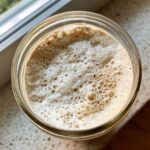
Learn how to create your own active sourdough starter using only flour and water. This guide provides a simple, day-by-day feeding schedule perfect for beginners to cultivate wild yeast.
- Prep Time: 5 min per day
- Cook Time: 0 min
- Total Time: 7 days (active maintenance)
- Yield: Approximately 100g active starter 1x
- Category: Baking Foundation
- Method: Fermentation
- Cuisine: American
- Diet: Vegetarian
Ingredients
Scale
- 100g Whole Wheat Flour or Rye Flour (for initial days)
- 100g Unbleached All-Purpose Flour (for maintenance)
- 100g Unchlorinated Water (room temperature)
Instructions
- Day 1: Mix 50g whole wheat flour and 50g water in a clean glass jar. Stir until fully combined. Cover loosely and let it sit at room temperature (68-75°F) for 24 hours.
- Day 2: You may see small bubbles or nothing at all. Discard half of the mixture. Add 50g whole wheat flour and 50g water to the remaining starter. Mix well, cover loosely, and wait 24 hours.
- Day 3: Discard half. Feed with 50g whole wheat flour and 50g water. You should start seeing more activity.
- Day 4: If you see consistent bubbles, switch to feeding with all-purpose flour. Discard half. Feed with 50g all-purpose flour and 50g water.
- Day 5: Discard half. Feed with 50g all-purpose flour and 50g water. You should see significant doubling in size within 6-12 hours after feeding.
- Day 6: Discard half. Feed with 50g all-purpose flour and 50g water. The starter should now reliably double in volume and show many bubbles. This is often when you have an active sourdough starter.
- Day 7 (and beyond): Your sourdough starter is ready for baking when it consistently doubles in size after feeding. Maintain by discarding most of it and feeding it a 1:1:1 ratio (starter:flour:water) every 12-24 hours, depending on your room temperature.
Notes
- Use a kitchen scale for accurate measurements; consistency in ratios is key for success.
- If your starter does not show activity by Day 5, move it to a slightly warmer spot (around 78°F) and continue feeding.
- If you see pink, orange, or fuzzy mold, discard the entire batch and start over.
- You can use sourdough discard in recipes like pancakes or crackers instead of wasting it.
Nutrition
- Serving Size: 100g
- Calories: 200
- Sugar: 0.5g
- Sodium: 1mg
- Fat: 0.5g
- Saturated Fat: 0.1g
- Unsaturated Fat: 0.4g
- Trans Fat: 0g
- Carbohydrates: 40g
- Fiber: 3g
- Protein: 6g
- Cholesterol: 0mg
Find it online: https://yumdrizzle.com/sourdough-starter-from-scratch-guide/